
Industries like aerospace, automotive, & civil widely use composite materials. Because these materials are lightweight & have high strength properties. But prediction of their properties & behaviour under fatigue loading & progressive failure is not straightforward. And traditional methods fall short in capturing complex failure mechanisms. This is where Abaqus user subroutines, such as UMAT & VUMAT, come into play.
Role of UMAT & VUMAT in Abaqus
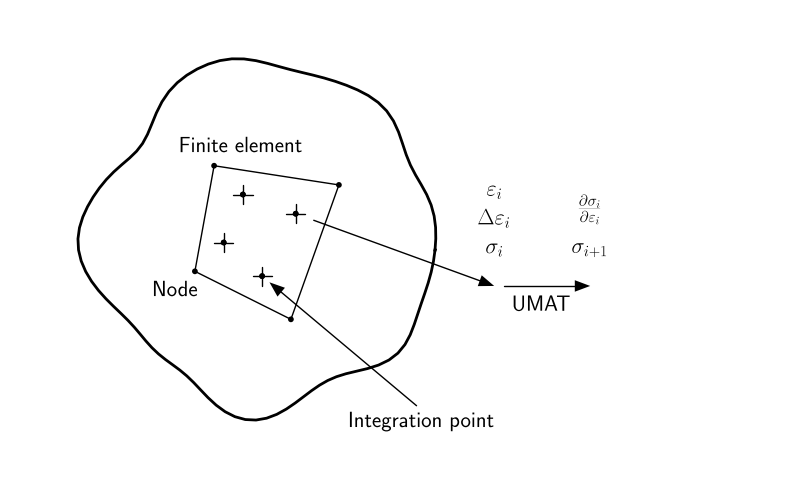
The Abaqus UMAT (User Material Subroutine) is used in Abaqus Standard. While Abaqus VUMAT is specifically designed for the Abaqus Explicit. Both allow the users to define custom constitutive models & to extend the capabilities of the software beyond the built-in options. This flexibility is crucial for composite fatigue & progressive failures.
For Example,
Engineers can implement stiffness degradation rules, fiber-matrix interactions, or nonlinear damage models that help reflect real-world material responses. A carefully written Abaqus subroutine ensures that the simulations can capture how composites gradually lose strength under the cyclic loading & eventually fail. Many researchers rely on an Abaqus VUMAT for developing more advanced models tailored to their applications.
Composite Fatigue Simulation
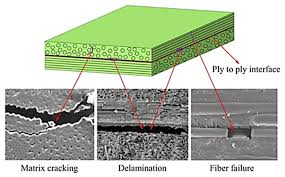
Fatigue in composite includes cracks, matrix cracking, fiber breakage, & delamination. And it often occurs simultaneously. Standard models cannot fully account for these mechanisms. But a Fortran Abaqus implementation allows the engineers to define custom rules for how damage evolves.
With UMAT & VUMAT, engineers can simulate:
- Progressive stiffness degradation over repeated stress cycles.
- Coupled damage mechanisms across multiple directions.
- Critical life predictions that match the experimental fatigue results.
This ability to control material response at a fine level of detail makes fatigue simulation more accurate & insightful as well.
Progressive Failure Analysis
Progressive failure refers to the gradual development of localized damage leading to overall structural collapse. By implementing advanced damage criteria into an Abaqus user subroutine, engineers can observe how microcracks evolve into larger fractures.
By using Abaqus UMAT, users can simulate quasi-static loading scenarios where failures occur gradually. With Abaqus VUMAT, explicit simulations of high-speed events such as impact or crash tests become possible. This is one of the versatile features of UMAT & VUMAT that are considered essential for engineers working with composites.
Way Forward
The use of UMAT & VUMAT in Abaqus provides engineers with the tools to move beyond the standard material libraries & achieve the realistic simulations of the composite fatigue & progressive failures. Writing the subroutines in Fortran requires expertise. And the result is great accuracy, better predictions & improved material designs.
For the industries where reliability & safety are non-negotiable, taking advantage of the Abaqus user subroutines is more than just an option; it’s a smart choice. And a step toward the most reliable, future-ready design.
Enhance your skills and master these techniques by enrolling in a Fortran Abaqus UMAT/VUMAT Course online for hands-on training and expert guidance.
Contact us today to get started!